

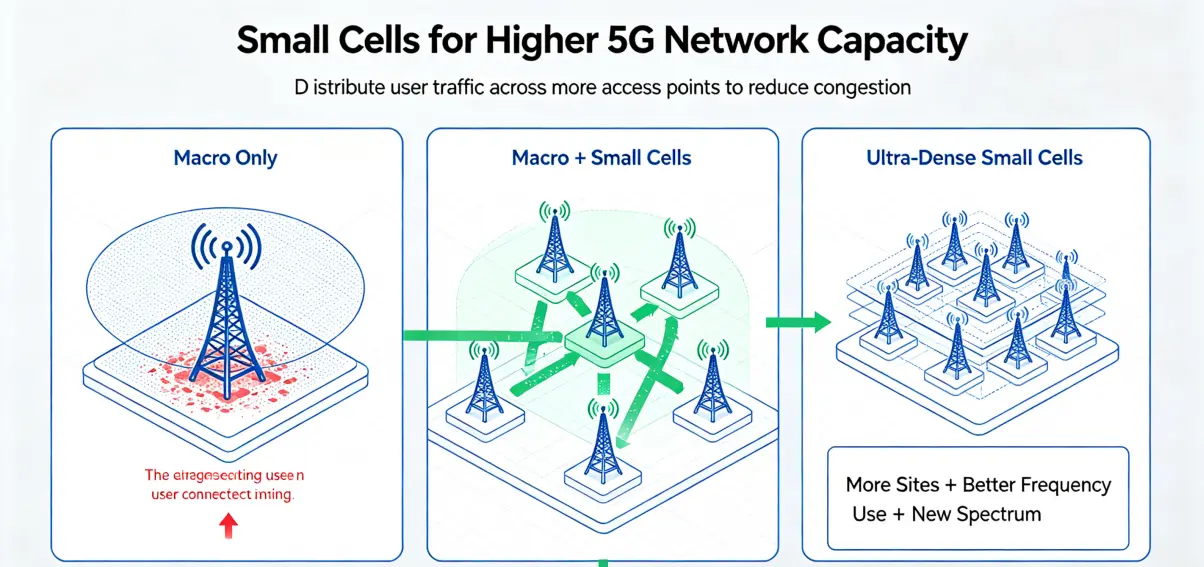
5G Macro Base Station Congestion: Key Advantages of Small Cell Deployment
The standard 5G small cell deployment model overlays multiple small cells within the signal coverage of a macro base station. Take Eastern Taipei as an example: a single macro base station can deliver full signal coverage for this district. However, dense crowds generate massive mobile data traffic, which requires higher network capacity. Deploying small cells around high-footfall locations such as shopping malls can greatly improve network throughput.
That said, macro and small cells require precise radio coordination to avoid mutual signal interference. Cell planning therefore faces new technical challenges. Interference may occur not only between macro sites and small cells, but also between adjacent small cells when deployed too densely.
There is a practical ceiling for capacity gains from small cell deployment. With current technologies, small cell networks can increase overall network capacity by 2 to 5 times at maximum.
China Mobile adopts a separate frequency band strategy for macro and small cells to mitigate interference. This frequency separation approach successfully eliminates cross-interference. Nevertheless, this solution may not be feasible in markets with multiple competing telecom operators and limited spectrum resources, where individual carriers rarely hold enough spectrum to implement such a scheme.
Why 5G Small Cells Are Indispensable
5G mobile networks break away from the traditional model that depends heavily on macro base stations. Mass small cell deployment allows telecom operators to build flexible, cost-effective networks, improving network density and coverage while delivering higher transmission rates and greater system capacity than 4G.
Growing demand for high-resolution video streaming, cloud services and entertainment applications, paired with a sharp rise in connected devices including smartphones, tablets and machine-to-machine communication terminals, is projected to drive global mobile data traffic up by 10,000 times over the next two decades.
According to Nokia Networks, 5G is designed as a scalable and flexible service system that delivers gigabit speeds with near-zero latency at key locations. Featuring higher peak data rates, 5G improves user data rates across all scenarios and cuts latency to one-tenth of 4G, delivering at least tenfold improvements in end-user experience.
The 5G ecosystem supports a broad range of use cases, including video streaming, augmented reality, data sharing, vehicle safety systems, remote sensors and real-time control. After commercial rollout starting in 2020 and full maturity by 2030, 5G must flexibly support emerging applications that have not yet been developed. In addition to traditional sub-6GHz radio bands, 5G leverages spectrum ranging from 6GHz to 100GHz. These frequency bands have distinct propagation characteristics and require innovative radio access technologies. While some vendors propose extending LTE air interfaces above 6GHz, custom streamlined air interfaces can better address specific technical bottlenecks.
For end-users, 5G should deliver seamless, transparent connectivity and maintain consistent service quality across the whole network. Network operators expect simple deployment and maintenance workflows. Therefore, 5G systems must achieve tight integration with legacy networks such as LTE via a unified Radio Access Network (RAN). This method simplifies infrastructure management spanning 2G to 5G and enables operators to roll out 5G services in phases.
Flexible network deployment and redesigned air interfaces help control power consumption growth. Power consumption per transmitted bit on both ends of the wireless link needs to drop substantially, especially for idle end-devices and underutilized network nodes. Flexible system design and deep integration with existing networks are top priorities for telecom solution providers, delivering up to tenfold improvements in user experience.
Four Core Strategies to Meet 5G Performance Targets
To achieve 1000x higher network capacity and tenfold better user experience (stable 100 Mbit/s even under poor network conditions), the industry relies on four key technical pathways:
- Massive densification of small cells
- Access to additional spectrum resources
- Improved spectrum efficiency
- New network design paradigms for ultra-dense deployment
Network densification has already been a visible trend for 3G and 4G. 5G enables a clean-slate design of flexible systems optimized for small cells spaced less than 200 meters apart. Existing LTE small cells are built on rigid wide-area macro cell frameworks. A clean-slate design unlocks better optimization and adaptability for dense small cell deployments. It is worth noting that besides ultra-dense small cell networks, 5G also supports wide-area macro cell deployment, which highlights the importance of system flexibility.
New Spectrum Resources: Centimeter Wave and Millimeter Wave
Demand for new frequency bands keeps rising. Up to now, most allocated mobile communication bands sit below 6GHz because lower frequencies support wide coverage. Even with more sub-6GHz spectrum and advanced technologies to improve spectrum utilization, demand for new radio bands continues to grow. Spectrum between 6GHz and 100GHz helps satisfy the high capacity and high data rate requirements of 5G.
Based on radio propagation properties and available carrier bandwidth, the 6–100GHz spectrum can be divided into centimeter wave and millimeter wave segments.
Centimeter waves share partial characteristics with conventional mobile bands, making them the first candidate for new radio access research. Their propagation behavior resembles traditional cellular spectrum in reflection and path-loss exponent, yet differs in overall path loss and diffraction, especially at higher centimeter-wave frequencies. Centimeter waves may deliver continuous bandwidth between 100 MHz and 500 MHz, exceeding the bandwidth supported by LTE-Advanced. LTE air interfaces originally optimized for 2GHz bands are not suitable for centimeter wave operation.
Millimeter wave spectrum starts around 30GHz. Its radio frequency and propagation characteristics differ from sub-6GHz bands, with higher diffraction and penetration loss through foliage and buildings. Recent measurement campaigns, however, show similarities with sub-6GHz spectrum in reflection properties and path-loss exponent.
Further experimental studies are required to fully validate millimeter wave performance. Such research will unlock carrier bandwidth options from 1 GHz to 2 GHz. The transition between centimeter wave and millimeter wave at 30GHz is gradual without abrupt shifts in radio propagation behavior.
Spectrum Efficiency, Massive MIMO and Beamforming
Spectrum efficiency measures how efficiently data is transmitted over radio spectrum, defined as bits per second per hertz. Massive MIMO serves as a core technology to boost spectrum efficiency.
Integrating large antenna arrays into centimeter and millimeter wave 5G air interfaces differs significantly from MIMO solutions deployed in 4G. First, many wideband systems above 6GHz are noise-limited and can adopt simpler schemes without aggressive inter-cell interference mitigation. Second, 4G systems below 3GHz are constrained by bandwidth and interference. Their MIMO implementations mainly focus on lifting spectrum efficiency to overcome those constraints.
Wideband millimeter wave systems are less limited by bandwidth and interference but suffer from severe path loss. In early deployments, MIMO will prioritize beamforming for power gain rather than spatial multiplexing, the key 4G technique for spectrum efficiency. Centimeter wave systems operate in an intermediate state between 4G and millimeter wave, adopting both MIMO and beamforming technologies.
Massive MIMO greatly improves link-level spectrum efficiency. System-level spectrum efficiency can be further raised by optimizing radio resource utilization. Interference rejection technology is one effective method: instead of LTE-style interference coordination that seeks quiet radio subframes, interference is accepted and suppressed at receivers. Interference rejection concepts have already been adopted in LTE, and 5G systems can be natively optimized for this mechanism. Dynamic TDD is another optimization tool, dynamically allocating uplink and downlink spectrum resources.
Dynamic TDD and Short Frame Structure for Low Latency
4G/LTE achieves lower latency than 3G but still falls short of wired internet performance. Dynamic TDD with short, reconfigurable frame structures is one method to cut radio access latency. Different base stations within the network can adopt different uplink/downlink splits according to real-time traffic load. Dynamic TDD becomes the dominant operating mode for ultra-dense 5G networks above 6GHz. It works well for small cells because spectrum resources can be assigned to uplink or downlink on demand. TDD transceivers are also simpler and cheaper to manufacture than FDD counterparts.
LTE-Advanced introduced dynamic TDD with limitations on uplink/downlink switching points. Its 10ms radio frame allows only two switching points, creating a hard bound on air interface latency. Due to backward compatibility constraints, LTE-A evolution cannot change numerology and frame structure to drastically reduce latency. New 5G air interfaces are required to hit physical-layer latency targets.
A well-designed frame structure removes switching-point restrictions, allowing any slot to be allocated for uplink or downlink. It also supports direct device-to-device links and self-backhauling. The TTI frame length for flexible 5G TDD is roughly one-tenth of LTE. This enables an overall latency target of 1ms, supporting automotive safety, tactile internet and real-time control applications.
Improved Energy Efficiency with Redesigned Air Interfaces
5G radio systems are engineered for low-power operation, supporting IoT sensors that can run for multiple years without recharging. Dynamic TDD helps with this objective by improving sleep-cycle efficiency and cutting power draw on end devices.
5G is also the first wireless communication system designed with infrastructure energy efficiency as a core requirement. This reduces environmental impact. Even with exploding air traffic, economic scale benefits reduce the energy consumed per transmitted bit. Each small cell in ultra-dense networks consumes far less power than traditional macro sites.
Small cells transmit at lower power levels. A typical pico cell consumes only several watts to tens of watts, while macro stations require hundreds of watts, serving vastly larger geographic areas and thousands of users.
Ultra-dense 5G networks serve fewer average users per cell at any moment, yet end users run diverse applications with variable data demands. Small cells operating on high-frequency bands need these capabilities: dynamic TDD with short transmission time intervals and low-overhead framing, massive MIMO with phased arrays and beamforming, plus direct device-to-device communication.
To optimize radio resource usage and energy efficiency, integration is required between small cell frequency layers and wide-area macro layers, or among multiple small cell layers. One network design example includes: a sub-6GHz wide-area layer with tens of MHz bandwidth, a centimeter-wave micro cell capacity layer with 100–200 MHz bandwidth, and a millimeter-wave indoor capacity layer with 1–2 GHz bandwidth. The simplest implementation assigns one network layer per connection based on coverage and service needs. However, use cases requiring ultra-reliability and stable latency demand tight cross-layer integration instead of isolated single-layer connections.
The underlying wide-area macro layer acts as a coordination plane. It steers user equipment connections to small cells and schedules radio resources across small cell sites. The macro layer also maintains signaling connections, while user data traffic is offloaded to small cells. As the device retains a fixed anchor point across large geographic ranges, mobility events are greatly reduced, improving reliability and mobility performance.
Conclusion: Ultra-Dense Small Cells as Core 5G Infrastructure
5G is an ultra-fast, highly flexible communication system with diverse technical components. It delivers invisible connectivity to end-users while remaining manageable for operators. It must handle massive traffic growth and satisfy capacity, data rate and latency requirements for new generations of connected devices.
To achieve 5G capacity and throughput targets, new spectrum resources and high-density small cell deployments are both essential. Ultra-dense small cells constitute a core pillar of 5G networks, deployed across a wide frequency range from sub-2GHz up to 100GHz, which calls for flexible system design. Centimeter-wave and millimeter-wave layers share common features: dynamic TDD, massive MIMO and beamforming, device-to-device communication, and low-overhead short frame structures. Differences between layers lie in bandwidth selection, MIMO/beamforming implementation schemes, and interference mitigation strategies.
System design must remain flexible to support varied services. Vehicle-to-vehicle communication requires ultra-high reliability, while low-cost IoT sensors only need basic reliability. High-throughput machine-type use cases can be supported by centimeter or millimeter wave bands, whereas simple IoT applications rely on low-power wide-area networks. Engineers must carefully evaluate energy consumption, infrastructure cost and terminal hardware performance when selecting 5G technology components.
The final challenge is to integrate diverse 5G solutions and multi-layer networks under unified network control, delivering consistent user experience. All radio access layers, together with legacy wireless technologies and their evolutions, work in tandem to provide optimal service quality.