

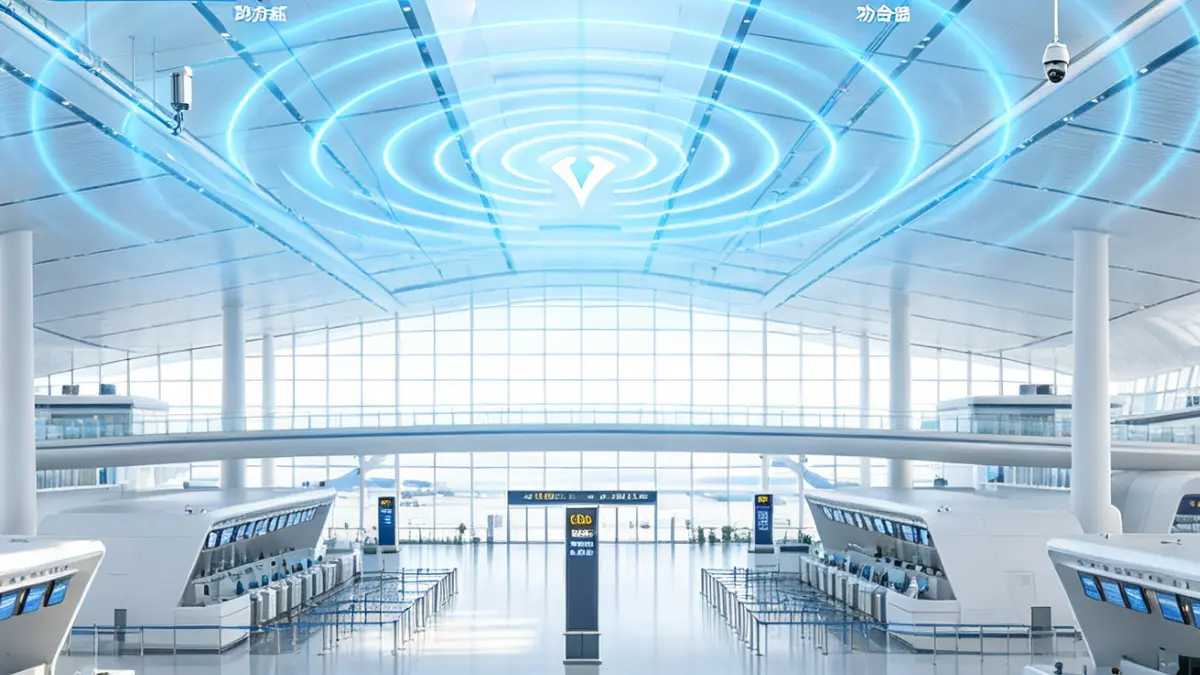
Optimizing Airport Connectivity: The Critical Role of Indoor Distributed Antenna System (DAS)
1. Introduction: Complex Wireless Challenges in Modern Airport Terminals
Modern airports are ultra-large, complex comprehensive transportation hubs with ultra-high passenger flow density and complex building structures. Featuring 10–20 meter high open halls, closed corridors, and large-area metal glass curtain walls, airport buildings cause severe signal attenuation of up to 25–30dB, forming numerous wireless signal blind spots and weak coverage areas. In addition, the peak passenger density in core terminal areas can reach 8–10 people per square meter, generating instantaneous massive data traffic.
Traditional macro base station deployment is far from meeting the high-standard communication needs of smart airports, prone to network congestion, signal disconnection and low-speed network problems during peak hours. In this context, the Indoor Distributed Antenna System (DAS) has become the core infrastructure to support full-coverage, high-capacity and stable wireless communication in airport scenarios, laying a digital foundation for smart airport operation and high-quality passenger service.
2. Core Value of DAS for Smart Airport Construction
The Indoor Distributed Antenna System realizes uniform coverage of wireless signals in all indoor and semi-indoor areas of airports such as departure halls, boarding gates, corridors, baggage claim halls and supporting service areas. It supports the coexistence of multiple networks including 5G public network, airport private communication network and security monitoring network, undertaking dual core functions of passenger service and airport operational guarantee.
For passengers, a high-quality DAS system ensures smooth 5G high-speed Internet access, high-definition video streaming and stable roaming experience, solving the pain points of full signal but low network speed in crowded scenarios. For airport operators, it supports intelligent management applications such as staff scheduling, real-time passenger information release, security monitoring and IoT equipment operation, effectively improving the overall operational efficiency of the airport.
3. Mainstream DAS Technical Solutions and Scenario Adaptation
Combined with the practical experience of 5G network construction in Changsha Huanghua Airport T3 Terminal, the industry has formed a mature multi-scheme integrated deployment mode of passive DAS and active DAS, realizing differentiated coverage for different airport functional areas.
3.1 Passive DAS: Cost-Effective Solution for Basic Coverage
The traditional passive distributed antenna system features flexible deployment, convenient coordination with building decoration and low initial construction cost. It is suitable for low-density and basic communication demand scenarios such as airport parking lots, office buildings and equipment rooms. With low operation and maintenance costs and stable performance, passive DAS can fully meet basic needs such as navigation and mobile payment, reducing project construction cost by about 40% compared with active schemes.
3.2 Active DAS: High-Capacity Guarantee for Core Areas
For core high-density passenger areas such as terminal waiting halls and international departure areas with concentrated high-bandwidth business demands, the active indoor distribution scheme dominated by pRRU equipment is the optimal choice. The "pRRU + directional/omnidirectional antenna" hybrid coverage scheme boasts 5–8 times the capacity density of traditional passive DAS, supporting 150 concurrent users per device while maintaining a user experience rate above 200Mbit/s. Meanwhile, it supports remote intelligent operation and maintenance, realizing precise fault alarm and rapid positioning, which greatly improves the efficiency of network maintenance and upgrade.
3.3 Outdoor Auxiliary Coverage: Innovative High-Pole Lamp Mounting Solution
For airport flight areas, runway and taxiway areas that are restricted by height limit and complex terrain, the innovative cooperative networking scheme of landscape tower macro stations, high-pole lamp mounted base stations and building roof stations effectively eliminates signal blind spots. The 12–15 meter high pole lamps are used as communication carriers to install directional antennas, realizing continuous and stable signal coverage in outdoor transition areas, and forming seamless network switching with indoor DAS systems.
4. Key Construction and Deployment Principles of Airport DAS
Airport wireless coverage construction adheres to the whole-cycle collaborative construction concept of synchronous planning, construction and acceptance with the main terminal project, avoiding rework and secondary transformation caused by post-decoration wiring. In the design stage, accurate technical parameter submission and BIM embedded design ensure 100% pre-embedding rate of pipelines. In the decoration stage, antenna equipment is highly integrated with interior decoration through sample verification and customized installation, realizing unified beauty of equipment concealment and signal coverage performance.
In terms of network optimization, through precise frequency planning and switching parameter debugging, a 5-meter seamless switching buffer zone is formed at the indoor and outdoor junction to ensure zero-sense network switching for users walking in and out of the terminal, realizing full-area blind-free and high-stability wireless coverage.
5. Our Professional RF Product Solutions for Airport DAS
High-performance radio frequency passive components are the key hardware foundation to ensure the stable operation of airport indoor distribution systems. Targeting the high-standard construction demands of airport 5G DAS projects, our enterprise provides a full set of matched high-quality communication products, including various high-gain antennas, power dividers, couplers and low-loss communication cables.
All our products feature wide frequency band coverage, low insertion loss, high isolation, excellent intermodulation performance and strong environmental adaptability, fully adapting to the long-term high-load operation environment of large airport hubs. We can provide customized combined product solutions for different airport coverage scenarios, supporting system integrators and engineering contractors to build high-efficiency, low-cost and easy-maintenance 5G indoor distribution systems for smart airports, empowering the high-quality development of airport wireless communication infrastructure.
Partner with us to accelerate your network expansion with optimized antenna performance. Contact our Engineering team @rd@weibonuo.com OR Sales department @sales@weibonuo.com today to discuss your project requirements or request custom RF product specifications.